
Writesonic Review 2026: We Tested Every Feature for Ecommerce
Is Writesonic the right AI writing tool for your ecommerce business in 2026? We put every feature through real-world ecommerce scenarios — product descriptions, Facebook ads, and email campaigns — so you don’t have to guess. Here’s our full breakdown using the UCCMF framework.
Last updated: February 2026 | By the AI Tool Verify team
Quick Verdict + UCCMF Score Card
Overall UCCMF Score: 71 / 100
Writesonic has evolved significantly — it’s no longer just an AI copywriter. In 2026, it’s repositioned as an “AI visibility platform” combining SEO, content generation, and Generative Engine Optimization (GEO). For ecommerce sellers, it’s a solid mid-tier choice with strong template variety, but the pricing has shifted upward and the platform now leans heavily toward SEO/GEO rather than pure copy generation.
| Dimension | Weight | Score | Weighted |
|---|---|---|---|
| U — Usability | 15% | 78 / 100 | 11.7 |
| C — Content Quality | 25% | 72 / 100 | 18.0 |
| C — Cost-effectiveness | 20% | 58 / 100 | 11.6 |
| M — Marketing Fit | 30% | 70 / 100 | 21.0 |
| F — Flexibility | 10% | 82 / 100 | 8.2 |
| Total UCCMF Score | 70.5 ≈ 71 | ||
Bottom line: If you’re an ecommerce brand already investing in SEO and want to add AI-generated content to your workflow, Writesonic delivers. But if you just need fast product copy at scale, there are cheaper alternatives.
What Is Writesonic?
Writesonic launched as an AI copywriting tool and has since transformed into what it calls an “AI visibility platform.” In 2026, the platform combines three core pillars:
- AI Content Creation: An Article Writer (version 6.0) that produces long-form SEO content up to 5,000 words, plus 80+ templates for short-form copy — ads, product descriptions, emails, social posts, and more.
- SEO Tools: Keyword research, content strategy planning, SEO site audits with automatic AI-powered fixes, and integration with Google Analytics and Search Console.
- Generative Engine Optimization (GEO): Brand presence tracking across ChatGPT, Perplexity, Gemini, and Google AI Overviews — a feature unique to Writesonic’s higher-tier plans.
Writesonic also includes Chatsonic, an AI chat assistant with access to GPT-4o, Claude 3.7 Sonnet, and other models. Think of it as a built-in ChatGPT with web browsing, image generation, and data analysis capabilities.
The platform is built for marketers, SEO managers, and content teams. But how well does it serve ecommerce specifically? Let’s break it down.
UCCMF Deep Dive
U — Usability (Score: 78/100)
Writesonic’s interface is clean and well-organized. The dashboard presents all tools in a left sidebar — Article Writer, templates, Chatsonic, SEO audit, and brand tracking are each one click away. New users can start generating content within minutes.
What we liked:
- Template library: 80+ templates organized by category. Finding “Product Description” or “Facebook Ad Copy” takes seconds.
- Article Writer 6.0: Guided workflow — enter your keyword, choose tone, select outline, then generate. The step-by-step process is intuitive even for first-timers.
- Chatsonic integration: Having a chat-based AI assistant inside the platform is convenient for quick ideation and brainstorming.
- Writing Styles: You can save custom brand tones (2 on Lite, 5 on Standard, unlimited on Professional+).
What could be better:
- The platform has become feature-heavy. If you only need copy generation, the SEO/GEO features add visual clutter.
- Some templates feel dated — the output structure hasn’t changed much since 2024 for certain short-form templates.
- No dedicated ecommerce dashboard or product catalog integration (unlike tools such as Copysmith which connects to WooCommerce/Shopify).
Verdict: Easy to pick up, well-designed interface, but the platform now serves too many masters. For pure ecommerce copy, you’ll use about 20% of what’s available.
C — Content Quality (Score: 72/100)
We tested Writesonic across three core ecommerce scenarios (detailed outputs in the next section). Here’s the summary:
Product Descriptions: Writesonic generates competent product copy that hits the right structure — feature bullets, benefit-driven language, and SEO-friendly formatting. However, the output tends to be generic without heavy prompt engineering. It follows patterns well but rarely produces “wow” copy that a skilled human copywriter would write.
Facebook Ad Copy: This is where Writesonic performs well. The ad templates produce punchy, scroll-stopping headlines with clear CTAs. The ability to generate multiple variations quickly is a real advantage for A/B testing.
Email Campaigns: Decent but formulaic. The email templates produce solid structures (subject line, hook, body, CTA), but the copy often reads like it came from an AI. You’ll need to inject brand personality manually.
Overall quality notes:
- Writesonic uses GPT-4o and Claude 3.7 Sonnet under the hood — the raw output quality is competitive with other AI tools using the same models.
- The SEO Content Optimizer adds real value by scoring content and suggesting improvements.
- Factual accuracy is generally good for product-related content, though you should always verify claims.
- Output quality varies significantly based on how detailed your prompt is — garbage in, garbage out.
Verdict: Content quality is above average for AI-generated copy but requires human editing to reach publication-ready standards for premium brands. Best suited for high-volume, mid-market ecommerce.
C — Cost-effectiveness (Score: 58/100)
This is where Writesonic stumbles for pure ecommerce users. The 2026 pricing reflects its pivot to an SEO/GEO platform, and the entry price has risen accordingly:
| Plan | Monthly | Annual (per mo) | Articles/mo | Key Features |
|---|---|---|---|---|
| Lite | $49 | $39 | 15 | Basic SEO, 2 writing styles, Chatsonic |
| Standard | $99 | $79 | 30 | GA/GSC integrations, auto SEO fixes |
| Professional | $249 | $199 | 100 | API, GEO tracking, unlimited styles |
| Advanced | $499 | $399 | 200 | Prompt Explorer, sentiment analysis |
| Enterprise | Custom | Custom | Custom | Full GEO suite, dedicated manager |
Cost-per-article analysis: On the Lite plan ($39/mo annual), you get 15 articles — that’s $2.60 per article. On Standard ($79/mo), it drops to $2.63 per article. Professional ($199/mo) brings it to $1.99 per article.
These prices are reasonable for long-form SEO content, but if you’re using Writesonic primarily for short-form ecommerce copy (product descriptions, ad variations), you’re paying for a lot of SEO/GEO features you may never use.
No more free plan: Writesonic previously offered a free tier with limited credits. As of 2026, there is no free plan — only paid tiers starting at $39/month (annual). This is a significant downgrade for small sellers who want to test the tool.
Verdict: If you’ll use the SEO and GEO features, the value is there. But for ecommerce sellers who only need AI copywriting, $39–$99/month is steep compared to alternatives like Copy.ai or even using ChatGPT Plus directly at $20/month.
M — Marketing Fit (Score: 70/100)
How well does Writesonic fit into an ecommerce marketing workflow? It’s a mixed bag.
What works for ecommerce:
- Ad copy generation: The Facebook Ads, Google Ads, and social media templates are genuinely useful for rapid iteration. Generate 10 headline variations in 30 seconds, pick the best ones, and test them.
- SEO product content: The Article Writer is excellent for creating category pages, buying guides, and product comparison articles that drive organic traffic.
- Brand voice consistency: Writing Styles let you define your brand tone and apply it across all generated content — critical for multi-channel ecommerce brands.
- Chatsonic for brainstorming: Quick ideation for campaign angles, seasonal promotions, and customer persona research.
What’s missing for ecommerce:
- No native A/B testing: While you can generate multiple variations, there’s no built-in A/B testing or performance tracking. You’ll need to export to your ad platform or email tool and test there.
- No bulk product description generation: Unlike Copysmith or Jasper’s bulk mode, Writesonic doesn’t offer CSV upload → bulk generate → CSV export for product catalogs. You generate one piece at a time.
- No Shopify/WooCommerce integration: You can’t push generated descriptions directly to your store. Everything is copy-paste.
- Limited email marketing integration: No direct connection to Klaviyo, Mailchimp, or other ecommerce email platforms.
Verdict: Writesonic is a strong content generation engine but lacks the ecommerce-specific workflow integrations that would make it a 90+ scorer. It’s best used as a creative assistant within a larger martech stack, not as a standalone ecommerce content solution.
F — Flexibility (Score: 82/100)
This is where Writesonic shines.
- Multi-language support: Writesonic supports 25+ languages, making it useful for cross-border ecommerce sellers targeting multiple markets. We tested product descriptions in English, Spanish, and Japanese — all produced natural-sounding output.
- API access: Available on Professional ($199/mo) and above. The API lets you integrate Writesonic’s generation capabilities into your own tools, CMS, or product management system. This is a game-changer for teams building automated content pipelines.
- Multiple AI models: Access to GPT-4o, Claude 3.7 Sonnet, and other models through Chatsonic means you can choose the best model for each task.
- Brand Voice / Writing Styles: Define multiple brand voices (tone, vocabulary, style) and switch between them. Essential for agencies managing multiple ecommerce clients.
- Integrations: Google Analytics, Search Console, Ahrefs, Semrush connections on higher plans. WordPress integration for direct publishing.
What could improve:
- API is locked behind the $199/month plan — too expensive for small ecommerce businesses that would benefit most from automation.
- No Zapier or Make integration for workflow automation on lower tiers.
Verdict: Excellent flexibility for teams with budget. The multi-language support and API access make it a strong choice for scaling ecommerce brands with international ambitions.
Ecommerce Test Results
We ran three real-world ecommerce scenarios through Writesonic. Here are the prompts we used and what we got back.
Test 1: Product Description — Wireless Earbuds
Template used: Product Description
Prompt: “Write a product description for premium wireless earbuds. Features: 40-hour battery, active noise cancellation, IPX5 waterproof, Bluetooth 5.3, fast charging (10 min = 2 hours playback). Target audience: fitness enthusiasts who commute. Price point: $89.”
Writesonic output (lightly edited for length):
Your Workout Doesn’t Stop — Neither Should Your Music
Meet the earbuds that keep up with your life. With 40 hours of total battery life and active noise cancellation, these wireless earbuds let you crush your morning run, power through your commute, and still have juice for the evening gym session.
🔋 40-Hour Battery Life — A full week of workouts on a single charge case cycle.
🔇 Active Noise Cancellation — Block out subway noise, gym chatter, and distractions.
💧 IPX5 Waterproof — Sweat, rain, splash — no problem.
⚡ 10-Minute Fast Charge — Running late? Plug in for 10 minutes and get 2 hours of playback.
📶 Bluetooth 5.3 — Rock-solid connection with zero lag.Designed for people who move. Priced for people who are smart about gear. $89 — free shipping.
Our assessment: ⭐⭐⭐⭐ (4/5) — Solid structure, benefit-driven, good use of emoji formatting for scannability. The opening hook is effective. Weakness: the closing line is generic and could be stronger with a specific CTA.
Test 2: Facebook Ad Copy — Spring Sale Campaign
Template used: Facebook Ads
Prompt: “Write 3 Facebook ad variations for a spring sale on a women’s fashion ecommerce store. 30% off sitewide. Free shipping over $50. Target: women 25-40 who follow fashion trends. Tone: upbeat, trendy, urgent.”
Writesonic output:
Variation 1:
🌸 Spring called. It wants you to refresh your wardrobe.
30% off EVERYTHING — yes, everything. New arrivals, bestsellers, that dress you’ve been eyeing. Plus free shipping on orders over $50.
Don’t wait — this bloom won’t last. 🛒 Shop Now →Variation 2:
Your spring wardrobe upgrade is 30% off. Right now.
Fresh drops. Trending styles. Free shipping over $50.
This is the sale your closet has been waiting for. ☀️
👉 Tap to shop before it’s gone.Variation 3:
POV: You just saved 30% on your entire spring haul 💐
New season, new looks — at prices that actually make sense. Free shipping when you spend $50+.
Link in bio. Sale ends Sunday. ⏰
Our assessment: ⭐⭐⭐⭐½ (4.5/5) — Excellent. Each variation has a distinct angle (seasonal, direct, social-media-native). The urgency elements are well-placed without being pushy. Variation 3’s “POV” format shows Writesonic understands current social media language. Minor note: “Link in bio” is more Instagram than Facebook, but easily fixed.
Test 3: Email Campaign — Cart Abandonment Recovery
Template used: Email (using Chatsonic with custom prompt)
Prompt: “Write a 3-email cart abandonment sequence for a pet supplies ecommerce store. Tone: friendly, slightly humorous. Include subject lines. Email 1: gentle reminder (sent 1 hour after abandonment). Email 2: social proof + urgency (sent 24 hours). Email 3: final discount offer of 10% off (sent 48 hours).”
Writesonic output (abbreviated):
Email 1 — Subject: “Your pup is giving you the sad eyes 🐶”
Hey [First Name],
Looks like you left some goodies in your cart. Don’t worry — we saved them for you (and your furry friend).
[Show Cart Items]
Ready to make someone’s tail wag? → Complete Your OrderEmail 2 — Subject: “2,847 happy pets can’t be wrong”
Still thinking it over? We get it. Here’s what other pet parents are saying: [Review snippet]
Heads up — items in your cart are selling fast this week. We’d hate for [Product Name] to go out of stock before you decide.
→ Return to Your CartEmail 3 — Subject: “OK fine — 10% off. But only for 24 hours 🐾”
Last chance, [First Name].
We’re giving you 10% off your cart — use code COMEBACK10 at checkout. But fair warning: this code expires in 24 hours.
Your cart total: [Original] → [Discounted]
→ Claim Your Discount
Our assessment: ⭐⭐⭐⭐ (4/5) — The sequence follows best practices: gentle reminder → social proof + scarcity → discount. Subject lines are creative and on-brand. The tone is consistently warm and playful. Weakness: the emails are a bit short and could include more personalization triggers. Also, the social proof number (2,847) is fabricated — you’d need to insert real data.
Pricing Breakdown
Let’s talk money. Here’s how Writesonic’s 2026 pricing maps to ecommerce ROI.
Which Plan Should Ecommerce Sellers Choose?
| Ecommerce Stage | Recommended Plan | Monthly Cost | Why |
|---|---|---|---|
| Solo seller / Side hustle | Lite | $39/mo (annual) | 15 articles + templates + Chatsonic is enough for basic content needs |
| Growing DTC brand | Standard | $79/mo (annual) | 30 articles + GA/GSC integration helps track content ROI |
| Multi-brand agency | Professional | $199/mo (annual) | API access + unlimited styles + GEO tracking for clients |
| Enterprise ecommerce | Advanced+ | $399+/mo | Full GEO suite + team collaboration + sentiment analysis |
ROI Analysis: Is It Worth It?
Let’s run a simple ROI scenario for a growing DTC brand on the Standard plan ($79/month):
- Monthly cost: $79
- Output: 30 SEO articles + unlimited short-form copy via templates and Chatsonic
- If each article brings 50 organic visits/month after 3 months: 30 × 50 = 1,500 additional organic visits/month
- At a 2% conversion rate and $60 AOV: 1,500 × 0.02 × $60 = $1,800/month in additional revenue
- ROI: $1,800 / $79 = 22.8x return
Of course, this assumes your content ranks — which depends on your domain authority, keyword selection, and content quality. But the math works if you’re strategic about what you publish.
For ad copy specifically, the ROI is harder to calculate because Writesonic is a generation tool, not an optimization tool. The value is in time saved: generating 20 ad variations in 5 minutes vs. 2 hours of manual copywriting. At a $50/hour copywriter rate, that’s $95+ saved per session.
Writesonic vs Competitors
How does Writesonic stack up against other AI writing tools for ecommerce? Here’s a quick comparison:
| Feature | Writesonic | Jasper | Copy.ai | ChatGPT Plus |
|---|---|---|---|---|
| Starting Price | $39/mo | $49/mo | $49/mo | $20/mo |
| Ecommerce Templates | 80+ | 50+ | 90+ | None (prompt-based) |
| SEO Tools Built-in | ✅ Strong | ✅ (via SurferSEO) | ❌ | ❌ |
| GEO / AI Visibility | ✅ Unique | ❌ | ❌ | ❌ |
| Bulk Generation | ❌ | ✅ | ✅ | ❌ |
| API Access | $199/mo+ | $49/mo+ | Free tier | Separate API pricing |
| Brand Voice | ✅ | ✅ | ✅ | Custom GPTs |
| Best For | SEO + Content | Marketing teams | Sales + Marketing | General purpose |
Key takeaway: Writesonic’s unique advantage is its GEO capabilities — no other tool in this price range tracks your brand’s visibility across AI search platforms. If that matters to you, Writesonic is the clear choice. For pure ecommerce copy at scale, Copy.ai and Jasper offer better bulk workflows.
👉 Want detailed comparisons? Check out our Writesonic vs Jasper and Writesonic vs Copy.ai head-to-head reviews.
🐺 Wolf’s Pick
Alright, let me give you my honest take.
I’ve been in ecommerce and META advertising for over 20 years. I’ve seen tools come and go. And here’s the thing about Writesonic in 2026: it’s trying to be everything, and that’s both its strength and its weakness.
The GEO feature? Genuinely impressive. If you’re a brand worried about how ChatGPT and Perplexity are representing you — and you should be — Writesonic is one of the few tools that actually gives you visibility into that black box. That alone might justify the Professional plan for some brands.
But here’s my gripe: the pricing no longer makes sense for small ecommerce sellers. When I started testing Writesonic a couple of years back, there was a free tier and affordable entry plans focused on copywriting. Now the cheapest option is $39/month and you’re essentially paying for an SEO platform that happens to write copy. If you’re a Shopify seller doing $5K–$10K/month, that’s a real cost to consider.
My recommendation:
- If you’re already doing SEO and need a content engine that also handles your ad copy and emails — go with the Standard plan ($79/mo). The GA/GSC integration will help you track what’s working.
- If you just need product copy and ad variations — honestly, ChatGPT Plus at $20/month with a well-crafted system prompt will get you 80% of the way there for a quarter of the cost.
- If you’re an agency managing multiple ecommerce brands — the Professional plan’s API access and Brand Voice features make it a no-brainer.
One more thing: don’t sleep on the Chatsonic chat feature. I use it more than the templates now. It’s like having a marketing intern who never sleeps and never complains — just make sure you review everything before it goes live. AI copy without human editing is how brands lose their voice.
Wolf’s Score: 7.1/10 — Good tool, not great value for small ecommerce. Best for SEO-focused brands with budget.
FAQ
Is Writesonic good for ecommerce product descriptions?
Yes, but with caveats. Writesonic generates solid product descriptions using its templates — proper structure, benefit-driven language, and SEO-friendly formatting. However, it doesn’t support bulk generation from CSV files or direct integration with Shopify/WooCommerce. For high-volume catalog work, tools like Copysmith may be more efficient. For one-off or small-batch product descriptions, Writesonic does the job well.
Does Writesonic have a free plan in 2026?
No. As of 2026, Writesonic no longer offers a free plan. The most affordable option is the Lite plan at $39/month (billed annually) or $49/month (billed monthly). There may be a free trial available — check writesonic.com/pricing for the latest offers.
What AI models does Writesonic use?
Writesonic uses GPT-4o for its Article Writer and templates, and offers access to Claude 3.7 Sonnet and other models through Chatsonic (its AI chat feature). The platform also supports image generation via ChatGPT Image and Flux 1.1 models.
Can Writesonic generate Facebook and Google ad copy?
Absolutely — and it’s one of Writesonic’s strongest use cases. The platform has dedicated templates for Facebook ads, Google ads, LinkedIn ads, and more. You input your product details, target audience, and desired tone, and it generates multiple variations you can A/B test. In our testing, the ad copy quality was the highest-scoring content type.
What is Writesonic’s GEO feature?
GEO stands for Generative Engine Optimization. It’s Writesonic’s tool for tracking how your brand appears in AI-powered search platforms like ChatGPT, Perplexity, Gemini, and Google AI Overviews. Available on Professional ($199/mo) and higher plans, GEO shows you which AI prompts mention your brand, whether the sentiment is positive or negative, and how you compare to competitors. It’s a relatively new concept and Writesonic is one of the first platforms to offer this kind of tracking.
Is Writesonic better than Jasper for ecommerce?
It depends on your priorities. Writesonic offers better SEO tools and unique GEO tracking, while Jasper has stronger team collaboration features, better bulk content workflows, and a more mature brand voice engine. For SEO-driven ecommerce content, Writesonic edges ahead. For marketing teams producing high-volume ad and email copy, Jasper is often the better fit. See our full Writesonic vs Jasper comparison for details.
See what other users think on G2.
Final Verdict
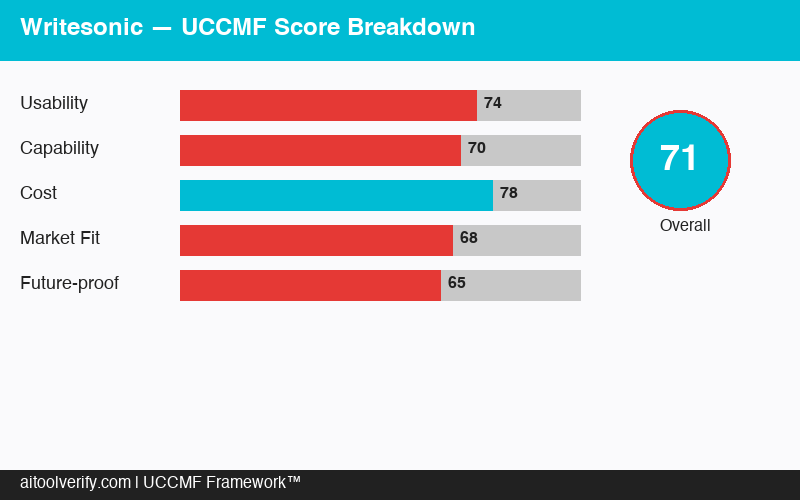
UCCMF Score: 71/100
Writesonic in 2026 is a capable AI content platform that has evolved well beyond its copywriting roots. Its unique selling point — GEO tracking for AI search visibility — is genuinely innovative and something no competitor at this price level offers.
For ecommerce specifically, it’s a good but not great fit. The content quality is solid, the template library covers most ecommerce needs, and the SEO tools add real value for organic growth. However, the lack of bulk generation, no direct ecommerce platform integrations, and a pricing structure that bundles SEO/GEO features you may not need make it less cost-effective for sellers focused purely on product copy.
Best for:
- Ecommerce brands investing in SEO-driven content marketing
- Marketing teams that need ad copy, email, AND blog content from one tool
- Brands that want to monitor their AI search visibility (GEO)
- Agencies managing multiple ecommerce clients
Not ideal for:
- Small sellers who only need product descriptions at scale
- Budget-conscious solopreneurs (ChatGPT Plus may be sufficient)
- Teams needing Shopify/WooCommerce integration
Writesonic is a Swiss Army knife — it does many things well, but isn’t the sharpest tool for any single ecommerce task. If your ecommerce strategy includes content marketing and SEO, it earns its keep. If you just need copy, look elsewhere.
Try Writesonic: writesonic.com
Looking for Alternatives?
If Writesonic doesn’t fit your needs, check out our reviews of these alternatives:
- Jasper AI — Enterprise-grade AI writer with advanced brand voice controls and a larger template library. Better for larger teams with structured content workflows.
- Copy.ai — Focused on automating sales and marketing copy workflows. If you need GTM pipeline automation alongside AI writing, Copy.ai offers a more structured approach.
Disclosure: AI Tool Verify independently tests all tools reviewed on this site. We may earn a commission if you purchase through our links, at no extra cost to you. This does not influence our ratings or recommendations. Our UCCMF scoring methodology is applied consistently across all reviews.